When to reach for a transient designer instead of a compressor
 Tensormix Team
A compressor squashes everything past the threshold. A transient designer reshapes the front and back of a sound independently, leaving the rest untouched. That's the difference between a blunt tool and a surgical one.
The snare hit has a click on top that won't quit. You drop a compressor on it, pull the threshold down, set a fast attack, and the click is still there, except now the body of the drum is squashed flat and the room tone behind it is breathing in time with the kick. You back off, try a slower attack, and the click gets louder. The compressor is the wrong tool. The problem is shape, not level.
That's the gap a transient designer fills. It doesn't care how loud the signal is. It cares about the difference between the front of a sound and what comes after, and it gives you two knobs to push those two things in opposite directions.
What a transient designer actually does
A compressor works by comparing the signal level to a threshold and reducing gain when it crosses. Everything downstream of that threshold gets the same treatment regardless of where in the envelope it happens to sit.
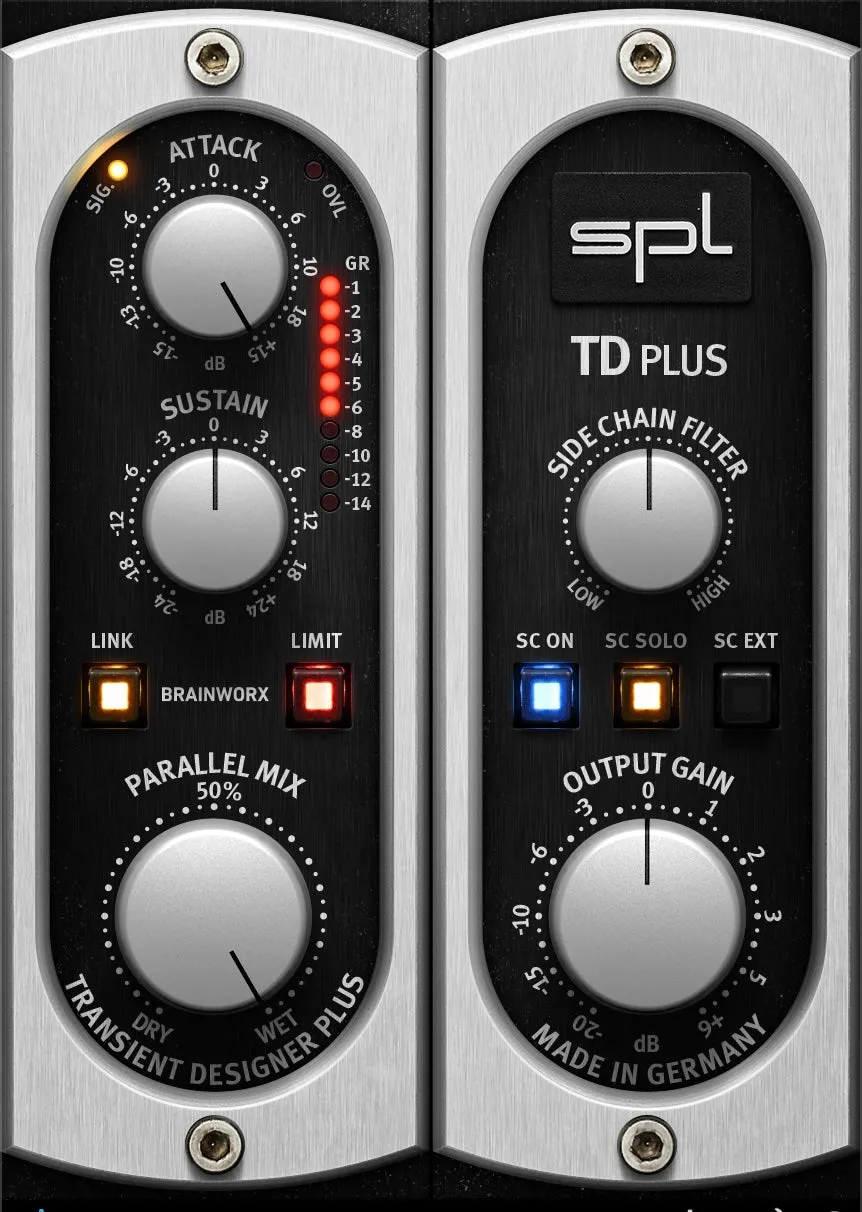
A transient designer generates two internal envelopes from the input: one that follows the signal accurately and one with a slower attack time. The difference between those two envelopes becomes the control voltage. Because nothing is being compared to an absolute threshold, the processing is level-independent. A quiet ghost note on a snare and a loud rimshot get shaped the same way. The Attack knob amplifies or attenuates the onset; the Sustain knob amplifies or attenuates the tail.
The SPL Transient Designer, which is the original of the breed (invented by Ruben Tilgner and first shown at ProLight + Sound in Frankfurt in 1998), gives you ±15 dB on each control. Most plugins have followed that range.
The practical consequence: you can boost the snare's attack by 4 dB and the body of the drum stays exactly where it was. You can pull the kick's sustain down by 6 dB and the beater click at the front is untouched. Neither of those moves is possible with a compressor without collateral damage.
When it beats compression
Drum room mics. A room mic captures the reflected wave a few milliseconds after the direct hit, so its onset is naturally soft compared to the close mics. Boosting Attack on the room channel sharpens that reflected onset, locking it back to the close mics so the room appears to slam in time rather than smear behind the kit. Boosting Sustain at the same time extends the reverberant tail. The SPL manual frames it directly: "If your drums happen to sound as if the room mics have been placed in a shoe closet, the Transient Designer can immediately turn that sound into the ambience of an empty warehouse."
Acoustic guitar pick attack. Compress a strummed acoustic and the pick click either survives intact (and gets harsher under heavier gain reduction) or gets crushed along with the body of the note. Cutting Attack by 2 to 6 dB on a transient designer softens only the onset. The body and the room tail stay where they are. A high-shelf EQ cut would remove brightness across the whole signal; a transient designer removes it only where the pick lives, at the front of each note. For surgical work on this, a frequency-selective shaper like Oeksound Spiff, or the sidechain filter on the SPL TD Plus tuned above 5 kHz, gets cleaner results than broadband shaping.
Boxy close-mic tails. A kick recorded in an untreated room rings in the low-mids after the beater hit. A gate cuts hard at a level threshold and chatters; a fast-release compressor pumps. Pulling Sustain down by 3 to 8 dB on the transient designer trims the decay shape without either artefact, and the beater click is left alone because Attack hasn't moved.
Reverb returns. Insert the transient designer after the reverb plugin and you're shaping the reverb's own envelope. Attack up, Sustain down gives you a sharp-onset short tail that no plate decay control can quite replicate. Attack down, Sustain up gives a reverse-swell effect on a forward-playing source. Useful as a creative move on drum sends and room returns.
When to leave it alone
If the signal is dynamically uneven (loud hits clipping, quiet hits disappearing), that's a compressor's job. The transient designer treats every hit the same way, which is exactly the wrong thing if you need consistency of level rather than consistency of shape.
If the source is fundamentally wrong (room was too small, mic was in the wrong place, performer played too hard), the transient designer can dress the problem but not solve it. Reshaping an envelope can extend what's there. It cannot manufacture character that was never captured.
And if you also want colour and glue, a compressor with a slow attack does some of what a transient designer does, plus adds tone. The trade-off is the slow-attack trick only works on signals loud enough to cross the threshold, so dynamic performances get inconsistent treatment.
Dialling it in
Start with both knobs at zero and confirm unity gain. Some plugins add gain at default.
Solo the track and move Attack first. Sweep from -6 to +6 dB slowly. Positive sharpens the hit, negative softens it. Get the onset feeling right before you touch anything else, because Attack and Sustain interact and chasing one with the other wastes time.
Move to Sustain. Boost in increments of 3 dB to extend body or room; cut in increments of 3 dB to tighten tails. Stop when the decay still tapers naturally. If it starts sounding gate-chopped, you've gone too far.
Unmute and listen in the full mix. Attack boosts always sound excessive in solo and correct in context. Sustain cuts always sound too dry in solo and tight in context. Trust the mix, not the solo.
If the result sounds plastic at full wet, pull the parallel mix knob back to somewhere between 20 and 40%. The Brainworx SPL TD Plus and Waves Smack Attack both have this built in; on an Enveloper or older plugin, route through an aux. Parallel processing lets you push the settings further and blend back to taste, which avoids the brittle, over-shaped sound that comes from extreme settings on an insert.
Watch your output meter after Attack boosts. A +4 dB Attack lift can spike peak levels by several dB on a close-mic in isolation even though the average barely moves. Pull the output gain down by 2 to 4 dB or engage the plugin's built-in limiter so the next plugin in the chain doesn't clip.
SPL demonstrating transient designer use on a sparsely-mic'd drum kit
The starting point worth memorising
Snare top, Attack +4 dB, Sustain 0. Listen in the mix. If the snare now reads as forward and present without sounding clicky, you've used the right tool. If you reached for a compressor first and ended up squashing the drum to chase the click, that's the moment to remember the two-knob box exists.