How Aphex Twin's drum programming on Drukqs still sounds impossible to copy
 Tensormix Team
Every hi-hat is a different pitch, every snare lands slightly off the grid, and a stretched break drifts underneath like a second drummer. Twenty-four years later, almost nobody can (or can be bothered to) replicate it.
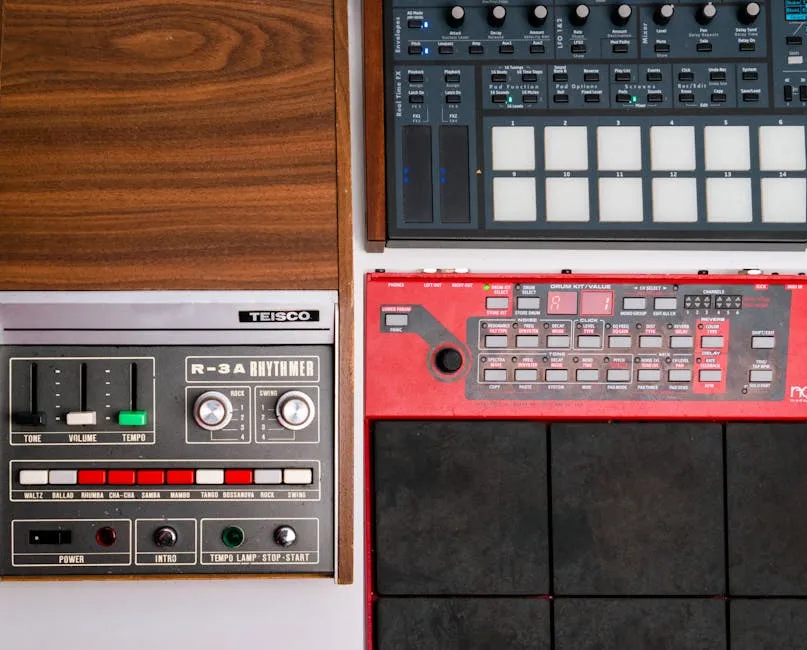
Put on Vordhosbn or 54 Cymru Beats and try to clap along. You either can't, or you can tell that it feels very off if you try - and not because the tempo is exotic. It sits around 170 BPM, which is just jungle. The reason your ear slides off the grid is that almost nothing in the percussion repeats. Every hi-hat is a slightly different pitch, every snare lands at a slightly different distance from the downbeat, and a smeared, half-recognisable break drifts underneath the whole thing like a second drummer playing in another room.
Twenty-four years later it still sounds like nobody else can quite copy it. The reason is partly tooling and partly workflow, and most of what made it work is reproducible in a modern DAW if you understand what's actually being done on the grid.
The tool that shaped the sound
Drukqs was sequenced almost entirely in PlayerPro, a Mac tracker that was already niche in 2001 and is now discontinued. James himself confirmed this in a Warp/Bleep storefront comment, writing that the album was "mostly written in Playerpro for the mac, my fave tracker" and that he "helped code a bunch of top dsp fx for it."
That matters because trackers don't work like a piano roll. A pattern is a vertical grid of rows, and every row is one event: a note value, a sample slot, an effect command, all entered as text. You're not drawing automation curves - you're typing pitch numbers into a column. This changes what's easy and what's hard. Drawing a smooth filter sweep is awkward. Giving every single hi-hat hit a different pitch is trivial: you just type a different note value on each row.
Almost every "impossible to copy" feature of the Drukqs drums follows from that.
Per-hit pitch as the engine of variation
The single biggest contributor to that alive, never-quite-repeating feel is that no two consecutive hits of the same sample share a pitch. A closed hi-hat run is one sample triggered at C#4, then D4, then C4, then D#4, then back down, across the bar. The formant shifts. The decay length changes (pitching a sample up shortens it, down stretches it). The overtone spread moves. To the ear it sounds like sixteen different hi-hats, but it's one sample with sixteen different note values in the pattern column.
The same applies to snares, rim shots, metallic hits, anything percussive with a recognisable pitch centre. On a piano roll this looks like a melody line, which is why staring at MIDI exports rarely tells you what's going on: the pitch data and the rhythmic data are the same column.
You can do this in any modern DAW. Load one drum one-shot into a sampler. In the piano roll, instead of repeating C3 every 16th, alternate four or five different MIDI notes within a two- or three-semitone range. Avoid runs of the same pitch longer than two hits. The pattern stops sounding like a loop almost immediately.
Micro-timing below the standard grid
Trackers quantise to rows, but the rows per beat are user-configurable. PlayerPro could be pushed to effective resolutions around 1/64th or 1/128th note, which means you can place events fractionally off a 16th grid by sliding them up or down a row or two. The result is timing that is placed deliberately on a finer grid than most sequencers expose, rather than quantised to 16ths or humanised randomly.
In a modern DAW, set the grid to 1/64 or finer and nudge specific hits 5 to 15 ms in a consistent direction. Snares slightly early, open hats slightly late, ghost notes pulled forward of the kick. Keep the offsets small and systematic. Bigger than about 30 ms and the brain reads it as sloppy playing or latency rather than groove. Random scatter doesn't work either; it has to have a direction.
This is the part most attempts at "IDM drums" get wrong. People reach for randomise-timing buttons and get jitter. James was placing hits, something that he and Burial have in common (both of their workflows are about as non-traditional as they get)
A library of low-bit one-shots, processed and frozen
The Drukqs kit is hundreds of single-hit samples taken from his hardware collection, stored in PlayerPro at low resolutions (8-bit, 22 kHz was the format constraint). The low-bit storage adds an inherent crunch and high-frequency roll-off that no clean modern sampler reproduces by default.
PlayerPro also let you bake processing onto a sample destructively. James valued this enough to describe it in detail, writing that "you could print plugin effects directly & destructively onto the sample, hence freeing up CPU, but you could hear the effect first before you printed it." The point in 2024 has nothing to do with CPU saving; a reverbed snare and a dry snare become two separate sample slots you trigger as different note events. A wet hit on beat 2 and a dry hit on beat 4 is just two notes pointing at two different files. There's no automated send to manage, no plugin recalculation, no risk of the processing drifting if you change tempo.
In a modern DAW, do this by rendering processed audio back to new files (Ableton's Freeze and Flatten, Reaper's Apply FX to items, Logic's Bounce in Place) and loading the printed versions as separate sampler slots. Keep the dry originals saved. The workflow is slow, but every snare in the pattern can carry its own treatment without a single automation lane.
The break underneath everything
Attack Magazine's deconstruction of Vordhosbn describes "a 170bpm, jungle-inspired flurry of chopped break and drum machine one shots", and crucially identifies a layer of timestretched break fragments running underneath the programmed kit. Stretching a 90 BPM break up to 170 BPM is roughly a 1.9x stretch, well past the point where any algorithm sounds clean. You get smearing, granular stepping, flange. Those artefacts are the point. They give the beat the bleed, room and human imperfection that pure one-shot programming can't supply.
The mistake is mixing the break too loud. Keep it 12 to 18 dB under the programmed layer and high-pass it above 400 Hz so it doesn't compete with the kick. It should be felt as movement, not heard as a second drum kit.
Aphex Twin - 54 Cymru Beats (Warp, 2001)
Why the percussion sounds out of tune with itself
There's one more layer that often gets missed. Some of the pitched percussion and the sinusoidal melodic fragments on Drukqs sit at non-standard tunings. Attack Magazine's writeup of Vordhosbn flags "a very digital, almost sinusoidal sound that pitch bends in surprising and unnatural ways" and notes pitches outside equal temperament. In a tracker, fine-tune offsets shift a sample by a fraction of a semitone, so you can drop a hit 14 cents below pitch and leave it there permanently as a stored value.
The effect on metallic and FM-derived sounds is disproportionate to the size of the offset. A snare detuned 30 cents flat against a bass note creates a low-grade beating that the ear reads as unease without being able to name it. Try it on any pitched percussion element: tune individual sampler voices to non-diatonic cent values and commit. Either go fully microtonal or map the percussion pitches deliberately into the track's key. The bad place is accidentally landing on a perfect fifth against the bass on every other bar.
What to actually do tonight
Open a sampler, load one drum hit, and program sixteen bars where no two consecutive triggers share a pitch and at least half the hits are nudged 5 to 15 ms off the grid in a consistent direction. Bounce three processed variants of the same hit (one reverbed, one distorted, one bitcrushed) as separate samples and alternate them in the pattern. Drop a 90 BPM funk break onto a track, stretch it to your session tempo, high-pass it at 400 Hz and bury it 15 dB under the kit. That's the recipe. The reason it still sounds impossible to copy is mostly that almost nobody is willing to enter that much data by hand.
And if there's one takeaway from both Aphex Twin's and Burial's workflows, it's that unique workflows produce the most unique results.